
 Model
Deep Plane Facelift Fort Worth & Colleyville
A natural, lasting lift
Over time, the collagen in skin breaks down and creates skin that sags and wrinkles. Facial Bones resorb and lose projection and youthful shape. Facial fat pads droop and drop to lower position, and resorb to become less full. This can cause hollowing and sagging to the face. This leads to the creases and wrinkles that causes many people to seek out a way to look better and to feel more confident about their looks.
What Is a Deep Plane Facelift?
Most of Dr. Smith's facelifts use the deep plane technique. He has performed hundreds of deep plane facelifts during his career, and his technique continues to evolve with current research.
The deep plane facelift works beneath the superficial musculoaponeurotic system (SMAS), the layer of muscle and connective tissue that supports the skin of the face and neck. Working beneath this layer in the midface, jawline, and neck allows Dr. Smith to release the key facial retaining ligaments that hold tissue in its aged position. Once these ligaments are released, the SMAS and the skin above it move together as one unit and can be repositioned over the deeper muscles of the face, restoring youthful shape and balance. Dr. Smith places tension only at the level of the fascia, so the skin closes without tension. That is what produces natural, long-lasting results without a pulled look.
Dr. Smith's Approach
In Dr. Smith's experience, his current deep plane technique:
- Minimizes separation of the skin from the tissue beneath it (skin delamination)
- Lowers the risk of a hematoma, a collection of blood beneath the skin
- Allows him to use Artiss tissue sealant instead of drains in most cases
Because of the tissue sealant, most of Dr. Smith's facelift patients go home without drains.
Deep Plane Facelift vs. SMAS Facelift
Both techniques work with the SMAS, but in different ways. In a traditional SMAS facelift, the skin is lifted off the SMAS, and the SMAS is then tightened from above by folding or stitching it, while the ligaments that tether it stay in place. In a deep plane facelift, Dr. Smith works beneath the SMAS, releases those ligaments, and moves the tissue as a single layer.
| SMAS facelift | Deep plane facelift | |
|---|---|---|
| Where the work happens | Skin is lifted off the SMAS, which is tightened from above | Beneath the SMAS |
| Retaining ligaments | Left in place | Released |
| Cheeks and midface | Limited improvement | Lifts the cheeks and midface |
| Where the tension sits | Shared between the SMAS and the skin | At the deep layer; the skin closes without tension |
| Typical recovery | Often slightly shorter | Usually 2-3 weeks |
Dr. Smith recommends the approach that fits each patient's anatomy. For most patients with aging in the cheeks, jawline, and neck, that is a deep plane face and neck lift.
What is a Facelift?
Facelift, aka rhytidectomy, is a surgical procedure to restore a youthful look to the face and neck. This usually includes repairing the bands of the neck, the jowls, the cheeks, and tightening the skin of the face and neck. The Brow and temples are not included in a facelift; however, they can be completed at the same time if you and your surgeon decide that this is necessary.
Natural-appearing results can be expected for men and women who choose facelift surgery. Dr. Smith will retain your look but ensure you look more refreshed and rested after the facelift is complete.
How is a Facelift done?
A facelift is performed at a qualified Fort Worth surgical facility or hospital. It involves incisions near the ears and hairline, so that they are hidden. The incisions can be various lengths, depending on the type and extent of the surgery that is needed.
You will consult with Dr. Smith to identify areas for improvement. After you have agreed on a strategy, he will give you information about how the surgery will be performed, explain what to expect, and answer any questions you might have. When you are ready to move forward, the team will help you book the facelift surgery on a day that works for you.
What Are the Benefits of Having a Facelift?
There are a variety of benefits to having facelift surgery. One of the most common reasons to choose a facelift is to address common signs of aging. A facelift can help with the following:
- Cheek Drooping
- Facial Volume Loss
- Fine Lines & Wrinkles
- Hanging Jowls
- Sagging Skin and muscles in the Neck
- Stubborn Fat
Something to keep in mind is that while a facelift is one of the best ways to rejuvenate the face, it does not address all facial aging issues. A different procedure will often be needed for aesthetic concerns in the forehead and eye areas. A comprehensive solution for cosmetic issues in these areas is the combination of a facelift with brow lift surgery and/or eyelid surgery.
What to Expect During Facelift Surgery
During facelift surgery, you will be under general anesthesia and feel no pain. The procedure typically takes at least 6 hours to complete, depending on what is needed. Dr. Smith will lift and tighten the deep layers of the face while adding minimal tension to the skin. This avoids a pulled look and ensures the facelift lasts an extended time, with minimal visible scarring. After the appropriate tissues are in the corrected position, and extra skin is removed, the incision sites are closed.
Most of Dr. Smith's facelifts use the deep plane technique described above, which looks more natural, lasts longer, and can address aging cheeks. Regardless of the chosen approach, Dr. Smith will tailor the treatment to meet your unique needs.
Does a Facelift hurt?
A facelift is a surgical procedure, so there is some mild discomfort associated with the procedure. We prescribe pain medication to keep patients comfortable for the first week while the patient heals.
Patients who experience extreme pain in the face and neck after surgery should notify Dr. Smith as soon as possible, as they may have a blood clot forming beneath the skin. This occurs in less than 2% of facelift cases.
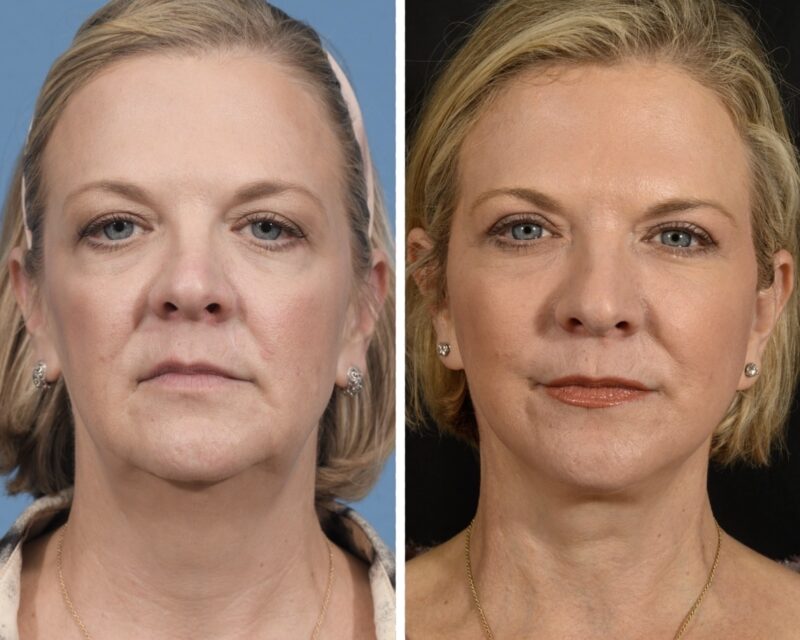
Facelift Before & After Pictures
Dr. Smith has performed thousands of facelift procedures. Here are a few examples.
How much does a Facelift cost?
A facelift in Fort Worth or Colleyville varies in cost depending on the surgeon's fee and facility fees taken together. There may be additional costs for the treatment based on the following:
- Location of practice
- Anesthesia fees
- Complementary procedures
- Specific concerns being treated
- Any pre- or post-op medications needed
- The specific facelift surgery chosen
Plastic surgeons’ fees take into account their training, experience, and talent in performing facelift surgery. As such, it is not recommended to choose a surgeon simply based on offering a facelift at a lower price than other surgeons. Your face is important, and you want the best person possible to work on it.
Your consultation includes a detailed written quote specific to your case.
Lower-Facelift vs. Mid-Facelift vs. Upper-Facelift?
Dr. Smith treats each patient as an individual. Not all people need a full face and neck lift; however, most people need some neck and jawline work done at the same time. Dr. Smith does the minimal amount of surgery to get the maximum results with the best longevity. Dr. Smith will speak with and examine you in the clinic at the time of your consultation. At that time you can discuss the details of your surgical procedure as well as express your desires. High-quality pictures of yourself can help Dr. Smith gather a better idea of what your wishes are.
What's a Mini-Facelift?
“Mini-facelift” can mean different things depending on the surgeon, but it often refers to a short-incision or “short scar” lift that targets the lower face and sometimes the upper neck. In many cases, it involves limited work beneath the skin.
While mini-lifts can look good at first, Dr. Smith finds that skin-only or limited mini-lifts often produce more modest, shorter-lasting results. A simple rule of thumb is that less work under the skin usually means less improvement and less longevity.
For patients who want longer-lasting rejuvenation of the cheeks, jawline, and neck, Dr. Smith often recommends a deep plane face and neck lift. It can involve a bit more healing and cost, but the goal is a more natural, durable correction. As Dr. Smith puts it: he can reset the clock, but he cannot stop it.
The best way to know which approach fits your goals is a consultation, where Dr. Smith can examine you and recommend the least amount of surgery needed to achieve the best, longest-lasting result.
Revision Facelift Fort Worth
Facelift revision addresses issues or aging results from a prior facelift. Reasons for considering a revision facelift in Fort Worth or Colleyville include dissatisfaction with original outcomes, complications like scarring or asymmetry, or simply the aging progression affecting the initial results. Dr. Smith uses a patient-specific approach, employing advanced techniques, typically accessing existing scars to minimize additional marking. Recovery mirrors that of an initial facelift with swelling and bruising dissipating within weeks. For best results, entrust this delicate procedure to a facial plastic surgeon, like Dr. Smith.
How long does a Facelift last?
It is always Dr. Smith's hope that your facelift will last at least 10 years. However, Dr. Smith always reminds his patients that they must do their part with proper skin maintenance procedures, good skincare, and sun avoidance. Incisions are made in areas that are largely concealed in order to reduce visibility.
What is Recovery from a Facelift Surgery Like?
Recovery time is dependent on the type of facelift performed. Deep Plane Facelifts take slightly longer to heal. Usually, 2-3 weeks are needed to heal from these. In most cases, after facelift surgery, patients may go home the same day. Because Dr. Smith uses a tissue sealant in most cases, most patients go home without drains. If desired, it’s also an option to stay overnight and receive constant care over the first day. Dressings will be changed during overnight stays for extra convenience.
On the first few days after surgery, it is recommended that the patient sleeps with the head elevated. Bruising and swelling may be seen, and typically take two to three weeks to go down.
After three weeks, most people feel confident returning to light exercise routines and office jobs. Vigorous exercise and strenuous activities should not be done until about four to six weeks after facelift surgery for the best results.
Dr. Smith and the team will provide you with attention and care to ensure your experience is comfortable, safe, and memorable. Follow-up appointments will be scheduled throughout your recovery to assess healing and answer any questions you might have.
How long do Facelift scars last?
Scars tend to start to lose their red color by 3-4 weeks after the operation. They can usually be covered with makeup at that time. All human scars take one year to fully mature and heal; however, most people do not notice a large difference in their appearance between months 4-12.
Things that speed recovery
Follow all directions before and after surgery just as they are written out for you.
The usage of oral Arnica and bromelain, both before and after the procedure, can reduce swelling, bruising, and bleeding.
Apply cool ice packs for the first 7-10 days. This should be done 3-4 times daily for 15 minutes at a time. Wait at least an hour before reapplying cool ice packs.
Sleep with the head elevated for the first 5-7 days.
No strenuous activity should be done for 10-14 days after your surgery. Dr. Smith will let you know when you can exercise again.
Facelift Recovery Time
The approximate recovery after facelift surgery is as follows:
Day 1:
Return home. Use cool compresses or ice for 24 hours.
Day 2-3:
Maximum bruising and swelling will be seen.
Days 5-7:
Stitches will be removed or start dissolving. Bruising should be starting to go away.
Week 1:
Wear the elastic garment at all times except when showering unless told otherwise by Dr. Smith. Repeat 2 times per day. Patients may use cover makeup to hide bruising if no chemical peel has been applied.
Weeks 2-3:
Wear the elastic garment at night only. Swelling should be much improved. Some areas of the face and neck will feel quite stiff. Residual bruising can be covered by make-up.
Facelift Post-Op
View Facelift recovery and post-op instructions on our Patients page
What Is a Non-Surgical Facelift?
A non-surgical facelift (liquid facelift) is a non-surgical procedure that relies on the effects of dermal injections into problem areas of the face. Dermal fillers (most often made up of hyaluronic acid, a substance naturally produced by the body) plump up the skin in the areas of concern. By doing so, they help to ease the signs of aging, volumize lines, tighten sagging skin, and soften wrinkles. The result is a more youthful appearance. In addition to combatting lines, wrinkles, and sagging skin, liquid facelifts can also help to plump up thin lips, fill in hollow cheeks, reduce scarring, and even fill hollow spaces under your eyes.
How Do Non-Surgical Facelifts Work?
At our clinics in Colleyville & Fort Worth, non-surgical facelift is achieved using what are called dermal fillers. These are injected into the layers of the facial skin. Over time, the collagen and elastin in our skin break down and the body’s rate of renewal slows. This can make the skin sag and leads to the formation of wrinkles, lines, and hollows. By injecting dermal fillers into the skin, those areas are plumped or filled, creating a youthful look, and effectively reversing the aging process. It is important to note that dermal fillers do not affect topical conditions, such as age spots.
What Is the Non-Surgical Facelift Procedure Like?
In most cases, a non-surgical facelift will take about an hour. The process begins with an initial consultation. You will sit down and discuss your goals with your surgeon, who will examine your skin and provide you with information and realistic expectations for the procedure. In some cases, a local or topical anesthetic may be provided to numb the areas to be injected.
The next step is to inject dermal fillers into the problem areas around your face. The number of injections will vary from person to person. Most patients will be able to have full correction in only one to two sessions. Once the injections are finished, you will sit for a few minutes in observation before being released. Recovery time is usually minimal, and any swelling or discomfort should resolve within 12 to 72 hours.
Are You a Good Candidate for a Non-Surgical Facelift?
Good candidates for this procedure want to rejuvenate their face and neck by reducing the appearance of lines, wrinkles, and hollow areas, but do not want to go through a surgical facelift. However, non-surgical facelifts sometimes do not achieve the dramatic differences possible with surgery. Speak with your surgeon to determine which procedure is best suited to your needs and goals.
Deep Plane Facelift FAQs
Is a deep plane facelift better than a SMAS facelift?
For most patients with aging in the cheeks, jawline, and neck, Dr. Smith prefers the deep plane facelift. Releasing the retaining ligaments lets him reposition the tissue without pulling on the skin, for a more natural and longer-lasting result. The right choice depends on your anatomy, which Dr. Smith assesses at your consultation.
How long does a deep plane facelift last?
It is always Dr. Smith's hope that a facelift will last at least 10 years. Good skincare, sun avoidance, and maintenance procedures help results last.
Will I need drains after a deep plane facelift?
Usually not. Dr. Smith uses a tissue sealant in most cases, so most patients go home without drains.
How long is recovery from a deep plane facelift?
Most patients need 2-3 weeks for bruising and swelling to settle. After three weeks, most people return to light exercise and office jobs. Vigorous exercise waits until about four to six weeks after surgery.
Who performs the surgery?
Every procedure is performed personally by Dr. Smith, a facial plastic surgeon who is dual board certified in facial plastic and reconstructive surgery and head and neck surgery.
Facelift Before & After


Every facelift begins with a private, in-person consultation

Schedule a private
consultation
Two locations across the DFW area. All consultations are conducted personally by Dr. Smith.
Fort Worth, TX 76104
Colleyville, TX 76034